CSDE NEWS & EVENTS

June 15, 2026

Congratulations to CSDE Trainees, Thanks to our Seminar Speakers and Organizers, and Best Wishes for the Summer

Congratulations and Enjoy the Summer!

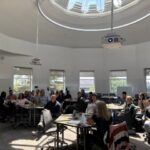
On Friday, June 5th, CSDE celebrated its many graduate students for their accomplishments. We enjoyed snacks, sharing updates, and celebrating! If you’d like to see all those updates, view the slide presentation.

Thank you to all who attended and presented at CSDE’s spring series. CSDE will be pausing its seminar series until Autumn 2026. Dr. Hyunmin Cha (Sociology) is organizing next year’s seminar series.  Feel free to contact him with your ideas.  Stay tuned for upcoming events. Thank you to our seminar series team – Professor Rawan Arar, Maddie Farris, Jessica Godwin, Jill Fulmore, and Rebecca Toole! Thank you to the Evans School for hosting us in Parrington Hall and supporting Rebecca.

In the meantime, keep sending us your news at csde@uw.edu! CSDE E-news will be shifting to a biweekly schedule over the summer.

(read more)


CSDE Research & Highlights

Sevcikova Teaches Module on Bayesian Population Projections in the European Doctoral School of Demography program

This year marked the first time that a dedicated module on probabilistic population forecasting was included in the European Doctoral School of Demography program, and it was taught by CSDE Research Scientist Hana Ševčíková and CSDE Affiliate Adrian Raftery (Statistics and Sociology). The course, taught May 18-22, 2026, focused on demographic state-of-the-art forecasting methods and introduced students to the foundations of Bayesian statistics, which play an increasingly important role in modern population research.

The European Doctoral School of Demography brings together doctoral student researchers from across Europe and beyond, creating a unique international environment for advanced demographic training. The program offers students the opportunity to learn from leading scholars in the field while fostering interdisciplinary collaboration and exchange of ideas across a broad range of population topics.

The week-long module on probabilistic projections which took place at INED in Paris, attracted highly engaged and curious doctoral students, who actively participated in discussions and asked many thoughtful and insightful questions throughout the course. Students showed strong interest in both the theoretical foundations and practical applications of Bayesian population forecasting methods, contributing to a lively and stimulating academic environment.

To arrange a consultation appointment with Hana Sevcikova or any of CSDE’s scientific support staff, please use the CSDE Science Core Consultation Request form.

(read more)


Acolin Publishes Cross-Disciplinary Framework for Addressing Adolescent and Young Adult Climate Distress

In a recent article published in PLOS Climate, CSDE Affiliate Jessica Acolin (Psychiatry and Behavioral Sciences) and co-authors present a framework for addressing adolescent and young adult mental health and distress related to climate change. The framework was developed through qualitative focus groups with experts who offered disciplinary perspectives across public health, pidemiology, community-based organizations, and clinical mental health practice. Three interdisciplinary themes emerged: Knowledge Generation (increasing scientific knowledge about the causes, consequences, and prevalence of climate distress and viable treatments); Framing and Communication (providing realistic hope without creating undue distress); and Resource Allocation (expanding funding and creative strategies for addressing mental health concerns given limited resources). Centering most-impacted populations and focusing on systemic rather than individual change emerged as meta-themes or guiding principles. (read more)


Sutton Shows Social Influencers Can Reduce Infection Burden and Modify Epidemic Lag in Group-Structured Populations

In a new article in Royal Society Open Science, CSDE External Affiliate Aja Sutton (CSDE T32 Alum, Population Research Center at Portland State University) with co-authors Adam Z. Reynolds (University of New Mexico), Matthew A. Turner (Stanford University), and James Holland Jones (Stanford University) examine how (digital) social influencers can modify epidemics by affecting social learning of health-protective behaviors in group-structured populations. Using agent-based models that incorporate both small protective and anti-protective nudges from social influencers into an epidemic scenario, they test how—under varying conditions of group structure modified by homophily and out-group aversion—competing influence messages affect health-protective behavioral diffusion between two behaviorally naive groups, and by extension infection transmission dynamics and outcomes. In heterogeneous populations, social influencers were protective of the whole population by increasing behavioral diffusion—independent of homophily—and flattening the epidemic curve, even in the equal presence of anti-protective messaging. Stronger group structure—especially, homophily—produced behavioral segregation and modified infection growth rates by accelerating within-group behavioral diffusion, leading to a lag between groups’ epidemic peak intensity and total infection burden. This work suggests contexts through which public health messaging is shared—such as social media sites, which exhibit a high degree of homophily—can produce substantial differences in disease transmission dynamics and epidemic outcomes.  (read more)


Anderson and EPAR Publish New Series on Data Choices with Consequences

CSDE Affiliate Leigh Anderson (Director of EPAR, Public Policy) and the Evans Policy Analysis and Research Group (EPAR) have launched a new series on “Choices with Consequences.”  The series of blogs and technical briefs illustrate the implications of alternative cleaning and variable construction decisions when constructing agricultural indicators, though applicable to other topics using household survey data. You can read the first brief on treating outliers, which also features a visualization tool to understand the implications of different identifying, trimming and replacing choices.  Key takeaways from this first "outlier" brief are:

  • Outliers, extremely high or low values of a continuous variable are common in survey data. They can be atypical but valid observations or the result of data collection or processing errors.
  • Appropriately handling outliers can reduce their distortion of summary statistics or analytical results, and transparency around methods can support reproducibility.
  • The outcome of an outlier treatment method depends on the type of measurement error that generated outlier observations, the overall sample size, the subgroups of interest, and the degree of variation across those subgroups.
  • We developed a simple tool to explore the consequences of different methods, using household survey data from the LSMS-ISA

The entire brief and tool can be found at: https://epar.evans.uw.edu/category/methods/choices-with-consequences/. And you can subscribe to EPAR's newsletter and announcements on this series by visiting their website at: https://epar.evans.uw.edu/

(read more)

leighanderson


Swanson Analyzes Racial Profiling in Washington State Patrol Traffic Stops

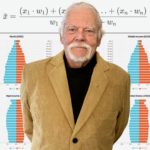
CSDE External Affiliate David Swanson (Distinguished Professor Emeritus, UC Riverside) authored a piece in NW Citizen analyzing racial disparities in Washington State Patrol (WSP) traffic stops from 2022–2024, using odds ratios applied to WSP Traffic Stop Demographic Report data. Black drivers faced roughly twice the odds of being stopped compared to White drivers in total traffic contacts across all three years, with considerably higher odds for criminal felony contacts and low-discretion searches. The pattern was consistent regardless of whether WSP or Office of Financial Management population data were used. Swanson argues the findings support legislative action to discourage pretext traffic stops as a means of reducing racial profiling. (read more)


Updates from the CSDE Research & Training Cores

Collaborate with CACHE to Host Your Code and Data 
Have you recently finished a project or published a paper that integrates social and health science data with disaster, climate or environmental data? Would you like to share your code on CACHE? Code can be in any language and will be reviewed and run by peers (CACHE post-docs and staff) before making it public.  (read more)


*New* CACHE Symposium at the GSA Annual Scientific Meeting 2026

CACHE will be at the GSA 2026 Annual Scientific Meeting, November 4 – 7 in National Harbor, MD, and is organizing a symposium “Pushing the Boundaries on Aging-Climate Topics and Methodologies”. To learn more about the GSA and to connect with leaders in aging and gerontology, find out more here. This year’s theme: “Reinforcing Resilience in Aging Science, Research and Education.”

(read more)


*New* NIH R25 Education Grants

NIH just released three Parent Announcements for R25 Education Grants, closing May 29, 2029.

(read more)

National Institutes of Health


Apply by June 15 to AI in Practice Summer Institute (07/27/26 – 07/31/26)

The eScience Institute at the University of Washington is offering a hands-on 5-day training (July 27 – 31) in AI methods for research, facilitated project work, and self-directed learning. Our event is designed for researchers looking to move beyond textbook examples and tackle the challenges of real-world applications. Applications are now open through June 15.

(read more)


*New* PAA Government & Public Affairs Virtual Office Hours (06/30/2026)

PAA is hosting Government & Public Affairs Virtual Office Hours on Tuesday, June 30, 2026 at 9 AM PT / 12 PM ET. During this off-the-record event, Mary Jo Mitchell, PAA/APC Director of Government Affairs will give a brief update about what is happening at the federal level of interest to the population sciences. Then you will be able to ask questions and engage with your colleagues.

This series is for PAA Members only. The event will not be recorded. Please register in advance.

The next Government Affairs virtual office hour will be Tuesday, September 29 at 9 AM PT / 12 PM ET. You can register for that one now as well.

(read more)


Call for Proposals: Office Of Naval Research (ONR) STEM Education and Workforce Program (06/30/26)

The Office Of Naval Research (ONR) seeks proposal under the ONR Science, Technology, Engineering, and Mathematics (STEM) Education and Workforce Program, due June 30, 2026 at 2 PM PT. STEM education programs and activities are defined as formal or informal education primarily focused on physical and natural sciences, technology, engineering, social sciences, and mathematics (including environmental science education or stewardship).

(read more)


Call for Papers: Journal of Population Research Special Issue on Place-based Demography for Regional Planning (06/30/26)

The Journal of Population Research invites invites contributions from population scholars—including demographers, population geographers and regional scientists—interested in the use of demography as a tool to inform territorial policies and regional planning. This special issue, “Place-based Demography for Regional Planning,” will be edited by CSDE External Affiliate Amy Spring (Georgia State) and Federico Benassi. 

(read more)


Call for Abstracts: Special Issue of Studies in Family Planning on Rethinking Contraceptive Futures (06/30/26)

Studies in Family Planning is calling for abstract submissions for a special issue on “Rethinking Contraceptive Futures,” by June 30, 2026. This call for abstracts invites contributions that broaden and challenge traditional understandings of contraceptive use, access, and meaning. Contributions may engage explicitly with family planning debates but should foreground contraceptive practices and their evolving meanings within broader social and demographic paradigms. 

(read more)


Expression of Interest Welcomed for FIS-2 project SOCIAL (Social Relations, Digital Technologies and Wellbeing of Older People) (06/30/26)
The FIS-2 project SOCIAL – Social Relations, Digital Technologies and Wellbeing of Older People is seeking expressions of interest by June 30 from potential candidates for future 18-month research appointments. Opportunities are available for both postdoctoral researchers and early-career researchers holding a Master’s degree. The project combines theory-driven social science research with advanced quantitative and computational methods to examine how social relationships and digital technologies shape wellbeing in later life. Candidates from a variety of disciplines are encouraged to apply, (read more)

SSRC LEGO Foundation Fellowship for Early Career Researchers (07/31/26)

The Social Science Research Council is pleased to announce the LEGO Foundation Fellowship, a new global research fellowship developed in partnership with the LEGO Foundation. Research themes of interest include:

  • the youngest children in crisis and conflict settings
  • inclusion and wellbeing for neurodivergent children
  • children’s thriving in an AI-enabled world

Applications are due July 31.  The fellowship will provide flexible support of up to $300,000 over three years for early- and mid-career researchers whose work can strengthen understanding of how children thrive across diverse contexts. 

(read more)


National Academies Research Associateship Programs (RAP) (08/03/26)

The National Academies of Sciences, Engineering, and Medicine invites applications by August 3 for the NRC Research Associateship Programs (RAP), a prestigious research fellowship program that is open to postdoctoral and senior researchers with a Ph.D., Sc.D., M.D., or D.V.M. (or near completion). These programs are designed to advance scientific discovery and innovation and provide the opportunity to design independent research projects, collaborate with leading scientists, and contribute to mission-driven innovation.   RAP offers more than 1,000 active opportunities to conduct research at participating federal laboratories and affiliated institutions at locations throughout the U.S.

(read more)


Register Now for 2026 Northwestern Main and Advanced Causal Inference Workshops (Starting 08/03/26)

The Northwestern Main and Advanced Causal Inference Workshop will hold its 15th annual meeting on Research Design for Causal Inference at Northwestern Law School in Chicago, IL. The  main workshop takes place Monday – Friday, August 3-7,  and the advanced workshop follows, Monday – Wednesday, August 10-12, with an optional machine learning primer on Sunday afternoon, August 9.

  (read more)


*New* Spencer Foundation Vision Grants: Express Intent to Apply by 08/12/26

The Spencer Foundation seeks proposals for Vision Grants up to $75,000 by August 12, 2026. The Vision Grant program provides scholars and collaborators with the time, space, resources, and support to plan a large-scale study or program of research: geared toward real-world impact to make education systems more equitable; drawing on research across disciplines and methods; and developed through meaningful and equitable collaboration with practitioners, policymakers, communities, and other partners; and focused on transforming educational systems.

(read more)


UW Royalty Research Fund Deadline is End of September 2026
As the spring quarter winds, here’s a reminder about the next Royalty Research Fund deadline at the end of September 2026. Submitting for that deadline will require work that overlaps with the summer quarter.  CSDE is happy to support the preparation and submission of your application.  Experienced faculty affiliates can help with reviewing the narrative of the proposal and our administrative team can prepare your budget. CSDE can also submit your RRF application for you.   (read more)


Call for Papers: Aftermath of a Pandemic – Changes in Mortality and Health (09/11/26)

IUSSP and its co-organizes invite papers for a workshop focused on “Aftermath of a Pandemic: Changes in Mortality and Health.” Post-pandemic periods can reveal or amplify existing health inequalities, and the effects of pandemics often extend beyond the acute phase of infection, influencing long-term patterns of mortality and overall population health. This workshop will focus on these poorly understood effects.

(read more)


Call for Papers: Special Issue of Studies in Family Planning on Pandemic and Epidemic Impacts on Reproduction, Sexual and Reproductive Health, and Family Dynamics (09/15/26)

Studies in Family Planning is calling for submission for a special issue on “Pandemic and Epidemic Impacts on Reproduction, Sexual and Reproductive Health, and Family Dynamics: Longer-Term Consequences and Cross-Crisis Perspectives,” due September 15, 2026. The special issue aims to broaden the field by situating COVID-19 within a broader landscape of pandemics and epidemics with demonstrable implications for reproduction, family life, and SRHR. 

(read more)


*New* Call for LOIs: Capland Foundation for Early Childhood (09/30/2026)

The Caplan Foundation for Early Childhood seeks LOIs by September 30, 2026. The Caplan Foundation for Early Childhood is an incubator of promising research and development projects that appear likely to improve the welfare of young children, from infancy through 7 years, in the United States. Welfare is broadly defined to include physical and mental health, safety, nutrition, education, play, familial support, acculturation, societal integration and childcare.

(read more)


Call for Nominations: 2027 IUSSP Early Career Awards (11/01/26)

The IUSSP Early Career Awards aim to honour outstanding contributions to the broad field of population studies by early career scholars in different world regions and boost the global visibility of their achievements. Nominate colleagues by November 1, 2026. Nominees must have received their PhD within the last seven years and be IUSSP members. For more information about the Award and the nomination procedure and to fill out the application form, please go to IUSSP Early Career Awards.

(read more)


Call for Contributions to Special Collection on Kinship Demography (12/15/26)

Demographic Research invites contributions to the Special Collection on Kinship Demography: Structures, Dynamics, and Inequalities in the journal Demographic Research, organized by Ashton Verdery, Bussarawan Puk Teerawichitchainan, Diego Alburez-Gutierrez, and Elena Maria Pojman. Submissions to this collection are possible from June 15, 2026 until December 15, 2026. Please find more information on the collection’s description and goals as well as on submission procedures here.

(read more)


*New* Call for Papers for the Special Collection “Measuring Population Health in the Era of Climate Change” in Population Health Metrics (02/26/27)

Population Health Metrics is accepting papers for the Special Collection “Measuring Population Health in the Era of Climate Change.”  The collection focuses on how climate change is reshaping population health and on methodological and empirical advances to measure these impacts. Submissions due February 26, 2027.

(read more)

OPPORTUNITIES

Demography Events

Conferences & Calls for Papers

Funding

Employment


CSDE
Center for Studies in Demography and Ecology
csde@uw.edu
206 Raitt Hall
(206) 616-7743
UW Box 353412
Seattle, WA
98195-3412
facebook twitter
Is this email not
displaying correctly?
View it online.
You are receiving this email because of an interest in Center for Studies in Demography and Ecology. To update your profile and subscription status, click here.