Welcome Back to CSDE! Enjoy Lunch and Catch Up with Colleagues on Friday 10/2 @ 12:30pm!
|
Please join CSDE on Friday (10/2) at 12:30pm (Location: Between Raitt Hall and Savery Hall) to celebrate the start of the 2026-2027 Academic Year! Catch up with your colleagues, meet new affiliates, staff members, fellows, and trainees, and find out what is new and upcoming at CSDE. You’ll have a chance to pick up your own Autumn Quarter 2026 Seminar Series Poster and enjoy food and refreshments. We want to send a huge shout-out to our new CSDE Seminar Series Chair, Hyungmin Cha, for his amazing work putting together the Fall 2026 Quarter Seminar Series!
We have a few updates to our leadership, Audrey Dorélien, along with being Training Core PI, will serve as CSDE’s Training Core Director. Audrey is faculty in the Department of Sociology and her research agenda strives to elucidate how human population dynamics and behavior intersect with environmental conditions to affect health. Additionally, CSDE welcomes our new Administrator Karoliina Kuisma! Karoliina has previously worked with the Department of Scandinavian Studies and the Department of Linguistics. She brings a great deal of experience and we are lucky to rely on her outstanding expertise!
Our seminar series this autumn quarter includes speakers covering the full array of population research topics. Leading off our speaker series on October 9 will be Jamaica Corker (Independent Researcher & Technical Consultant with her presentation on Family Planning Indicators in Global Monitoring Frameworks: The UN Population Division's experience with the MDGs and SDGs. On October 16, Matthew Randolph (American Ethnic Studies) will give a talk on "A More Proper Place of Refuge": Rethinking Asylum History through African American Migration to Haiti. On October 23, Joan Casey (Environmental & Occupational Health Sciences) joins us again to present Here We Go Again: Repeated Wildfire Smoke Exposure and Health Risks in the US.
On October 30, we welcome Apoorva Jadhav (Johns Hopkins University) for her talk The Dividend and the Denominator: Why Demography Matters in Public Policy.
Hyunju Kim (Epidemiology) joins CSDE on November 6 to present on Leveraging Metabolomics and Proteomics to Advance Our Understanding of the Dietary Approaches to Stop Hypertension (DASH) Diet: Objective Biomarkers and Potential Mediators. On November 13, Rachel E. Moran (Information School) will present The Future of “Trust & Safety”: Examining the Shift to AI in Online Safety Efforts.
On November 20, Raheem Chaudhry (Evans School) will speak on The Effects of Receiving Rental Assistance on Early Adulthood Outcomes. On December 4, Paula Saravia (Anthropology) will give a talk on Navigating the Double-Edge of Statistics: Indigenous Health, Patient Activism, and Collective Care in Chile.
Last, but definitely not least, December 11 will be CSDE’s very enjoyable Lightning Talks and Poster Session. For those of you who are new, this is a great time to learn more about the research of our students and to mingle and talk with each other!
For those of you who are new to CSDE, be sure to sign up for our calendar of events and our weekly e-news. The former includes our workshops and weekly seminar series and the latter includes a host of updates about CSDE affiliates’ accomplishments and opportunities for grants, conferences, publications, new research resources, etc. Don’t forget to send your news to csde@uw.edu!
(read more)
|
 |
|
|
King County, WA Point-in-Time Data: People Living in Vehicles, 2026 (Short Report)
|
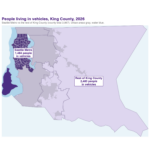
CSDE Affiliate Zack W. Almquist (Sociology) and colleagues at the King County Regional Homelessness Authority have published the first in a series of reports on unsheltered homelessness in King County, focused on people living in vehicles. Using respondent-driven sampling surveys from 2022 to 2026, the report estimates roughly 3,967 people living in cars, vans, and RVs on a single night in 2026, or about 5,460 over a full year, with breakdowns by vehicle size and geography, and covers health, domestic violence, service needs, and families with children. It recommends sanctioned safe parking with hygiene, dump-station, and pet-friendly capacity as the most direct response. Visit this link to read the full King County, WA Point-in-Time Data: People Living in Vehicles, 2026 Report.
(read more)
|
 |
Shin Receives Grant on Implementing a Team-Based Care Model to Increase Cervical Cancer Screening Uptake in Low-Resource Primary Care Settings
|
This month, CSDE Affiliate Michelle Shin (Child, Family, and Population Health Nursing) received a Mentored Clinical Scientist Research Career Development Award from the National Cancer Institute for her project titled, “Implementing a Team-Based Care Model to Increase Cervical Cancer Screening Uptake in Low-Resource Primary Care Settings.” Community health centers often are the sole providers of cervical cancer screening in underserved communities, but screening uptake remain persistently low. This clinical trial will engage an interprofessional team of primary care providers, medical assistants, and nurses to select and adapt existing evidence-based strategies into a team-based care model and pilot it in their practice settings. The findings will result in a practical model tailored to increase cervical cancer screening in communities experiencing disparities. Congratulations Dr. Shin!
(read more)
|
 |
Su Receives Notice of Award from the National Institute of Health
|
Recently CSDE Affiliate Yanfang Su (Global Health) received a Notice of Award from the National Institute of Health for her project titled, “Leveraging Existing and Accessible Data to Reduce Sodium Intake and Prevent Cardiovascular Diseases in U.S. Counties through Community-Engaged Policy Implementation (LEAD-US)”. This grant was originally developed during CSDE’s Grant Writing Summer Program. Su’s proposed research will examine how Americans consume about 3,400 mg of sodium (Na+) each day, nearly 50% higher than the limit recommended by the Dietary Guidelines for Americans. Excess Na+ is the leading dietary risk factor for cardiovascular disease (CVD), which causes roughly 950,000 deaths and accounts for 39.5% of all deaths in the U.S. each year. Reducing Na+ intake at the population level is an effective and scalable strategy for hypertension control and CVD prevention. Recent evidence shows that much of the systolic blood pressure (SBP) lowering effect comes from increased dietary potassium (K+) rather than decreased Na+. Dr. Su’s proposed project will rigorously assess healthy food policies that influence the dietary Na/K ratio. Her team’s objective is to assess the reach, effectiveness, adoption, implementation, and maintenance (RE-AIM) of pragmatic local policies that promote healthier foods. The long-term goal is to reduce CVD burden by providing institutional purchasers and food consumers with evidence to inform healthier procurement and dietary decisions.
Congratulations Dr. Su!
(read more)
|
 |
Morris Publishes in Children and Youth Services Review on School Racial Discrimination and School Connectedness Among Racially Minoritized Youth
|
CSDE Affiliate Kamryn Morris (Social Work) recently published a research article in Children and Youth Services Review titled, “Risk and resilience: an analysis of school racial discrimination and school connectedness among racially minoritized youth.” To date, the link between school connectedness and some risky behaviors has been well established. However, many studies fail to account for this process among racially minoritized youth or consider how racial discrimination influences this association. Dr. Morris and her colleagues extend prior work by incorporating school racial discrimination and a broader set of risky behaviors (e.g., substance use, mental health, social media use), showing that school connectedness supports mental health and protects against discrimination, while discrimination heightens risky behaviors, with race‑specific patterns that point to multifaceted implications for reducing health disparities.
(read more)
|
 |
Patwardhan Publishes in International Journal for Equity in Health on Examining the Association Between Structural-Level Patriarchy and Intimate Partner Violence
|
CSDE Affiliate Vedavati Patwardhan (Evans School Policy Analysis and Research Group) and her co-authors recently published a research article in the International Journal for Equity in Health titled, “Examining the Association Between Structural-Level Patriarchy and Intimate Partner Violence: Evidence from India’s National Demographic and Health Survey.” Dr. Patwardhan and her co-authors examined whether structural patriarchy at the district level is associated with intimate partner violence (IPV) against women in India, using mixed-effects logistic regression. Unlike prior research that often uses individual-level proxies for patriarchy, they use a validated structural patriarchy index to nationally representative data from NFHS-5 (61,180 women aged 18-49). They find a positive relationship between structural patriarchy and IPV, even after accounting for caste, religion, wealth, gender attitudes and behaviors, and sociodemographic characteristics.
(read more)
To read the full research article, visit this link.
|
 |
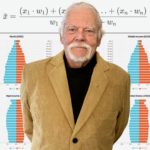
Dialogue with David Swanson on Probabilistic Population Forecasting and Deep Structure Learning in Springer Nature Research Communities
|
|
CSDE Now Hosts a Population Research and Policy Webpage
*New* UW Data Collaborative (UWDC) Corner: Meet with Data Axle for Data Product Updates & Q&A (09/23/26)
|
Wednesday, September 23 | 11:00 a.m. to 12:00 p.m.
Raitt Hall, Room 221, UW Seattle Campus
Join us for an informal discussion with Scott Lea, Data Axle’s representative, during his visit to the UW Seattle campus. Scott will share product updates and answer questions about Data Axle data and its research applications.
This session is open to UW faculty, researchers, staff, and students who currently use Data Axle data, are interested in exploring the data for future research projects, or would like to learn more about this research resource.
RSVPs are appreciated. To RSVP, please contact UW Data Collaborative (UWDC) Co-Director Sofia G. Ayala at sgayala@uw.edu.
(read more)
|
 |
*New* Reminders and Resources for UW Principal Investigators
|
CSDE PIs please be sure to keep your required trainings up-to-date and visit the PI resource page to find what you need! If you’ve never taken it, be sure to take the required Grants Management Training. In addition, be sure to create your SciENcv account and generate your biosketch and current and pending support. Once you do so, it is easy to make updates and that will make your life easier when applying for grants and being included on others’ grant applications.
(read more)
|
 |
NIH: Just-in-Time Submission Process Change
|
Effective August 12, NIH updated the functionality of the Just-in-Time (JIT) Module in eRA Commons, with impacts to the UW process for JIT submissions.
With this recent change, the Administrative Official (AO) role no longer has access to the JIT Module. The Principal Investigator (PI) and the Signing Official (SO) are now the only roles authorized to access JIT submissions. Neither the PI nor the SO can grant access to other persons, either by individual account or by role; the PI also cannot delegate authority to someone with an ASST role.
Moving forward, PIs need to upload all required JIT materials directly into eRA Commons before notifying OSP to proceed with review and submission.
(read more)
|
 |
Follow CSDE Social Media Accounts: Instagram, LinkedIn, & Bluesky
*New* Open course by MPIDR on Topics in Digital and Computational Demography (Hybrid, 2-6 Nov 2026, Application Deadline 9/25/26)
|
Topics in Digital and Computational Demography
Rostock, Germany & Online, 2-6 November 2026
- Application deadline: 25 September 2026
The course will be offered in a hybrid format: in-person for students in the IMPRS-PHDS network who are already in Rostock; online (via Zoom) for everyone else.
(read more)
|
 |
*New* FemQuant Seminar: Exposure to Local Violent Crime and Abortion, Miscarriage, and Stillbirth in Mexico (09/29/26)
|
Seminar—Exposure to Local Violent Crime and Abortion, Miscarriage, and Stillbirth in Mexico
Tuesday, September 29, 2026 at 8am ET/1pm BST/2pm CEST (Check in your time zone here)
Sign up to receive the Zoom link on the day.
(read more)
|
 |
Caplan Foundation for Early Childhood: Early Childhood Grants (09/30/26)
|
Award amount: Undisclosed award amount, but past amounts have averaged around $50,000.
Sponsor deadline: 09/30/2026
Description: The Caplan Foundation for Early Childhood is an incubator of promising research and development projects that appear likely to improve the welfare of young children, from infancy through 7 years, in the United States. Welfare is broadly defined to include physical and mental health, safety, nutrition, education, play, familial support, acculturation, societal integration and childcare.
(read more)
|
 |
Call for Papers: IJPDS Special Issue on AI in Population Data Science (09/30/26)
Association of Croatian American Professionals (ACAP) 10th Annual Conference: Optimizing Your Performance Strategies to Thrive in a High-Demand Professional Life (10/01/26)
|
This October, Association of Croatian American Professionals (ACAP) is having its 10th annual conference taking place in Seattle. As a part of it, on October 1st, ACAP is organizing a pre-conference health-focused symposium Optimizing Your Performance, which features a number of experts on brain health, performance under pressure, and life balance. This event is open to the public and free of charge, and more information is available here: https://conference.croampro.com/pre-conference-symposium/.
(read more)
|
 |
Russell Sage Foundation: Request for Articles: Wealth and Family Economics: How Much Wealth Is Needed to Achieve Social and Economic Benchmarks? (10/08/26)
|
Call for Papers
ISSUE ON “Wealth and Family Economics: How Much Wealth Is Needed to Achieve Social and Economic Benchmarks? Insights from New Measures and Concepts”
Editors:
Marybeth J. Mattingly*
Federal Reserve Bank of Boston
Jeffrey P. Thompson*
Federal Reserve Bank of Boston
(read more)
|
 |
*New* US Census Event: Data Are Made, Not Found: A Story of Politics, Power, and the Civil Servants Who Saved the US Census (10/19/26)
Sheldon Danziger Pipeline Grants Competition Application Deadline (10/21/26)
|
The Sheldon Danziger Pipeline Grants Competition for early-career researchers supports early-career scholars who are underrepresented in the social sciences and/or who are employed at under-resourced institutions. The competition seeks to support a cohort of scholars who are diverse in their geographic origins, life experiences, and community backgrounds. Only researchers who have not previously received a trustee or presidential research grant or fellowship from RSF will be eligible to apply. The proposal deadline for the seventh annual competition is October 21, 2026, at 2PM ET for funding starting in Summer 2027.
(read more)
|
|
*New* FemQuant Seminar: Quantification as an Epistemic Practice: Activist Documentation of Anti-Trans Violence in Brazil (10/29/26)
|
Seminar—Quantification as an Epistemic Practice: Activist Documentation of Anti-Trans Violence in Brazil
Thursday, October 29, 2026 at 10 ET/2pm GMT/3pm CET (Check in your time zone here)
Sign up to receive the Zoom link on the day.
(read more)
|
|
CACHE: 2026 Call for Seed Grant Proposals (10/30/26)
|
The Center on Aging, Health, & Environment has a new call out for seed grant proposals. Additional information here!
Proposal Deadline: October 30, 2026
(read more)
|
 |
Call for Papers: IJPDS Focus Issue on People and the Criminal Justice System (10/30/26)
|
People who have contact with the criminal justice system experience disproportionate social and health disadvantage both prior to and following their justice involvement, compared to the broader community. Achieving equity in areas such as health, housing, and education among people with justice system involvement should be a global priority. Simultaneously, the need to reduce offending and recidivism is central to improving public safety, strengthening justice system legitimacy, and reducing future victimisation.
(read more)
|
 |
Call for Papers for a Special Issue of The Milbank Quarterly on How Policy Contexts Impact Population Health in the United States (11/01/26)
|
In partnership with the Center for Aging and Policy Studies and Center for Policy Research at Syracuse University, The Milbank Quarterly will publish a special issue to advance knowledge on the connections between policies and population health in a changing U.S. context. The special issue seeks empirical, methodological, and theoretical contributions on the topic. Of particular interest are papers that link changes and variation in policy contexts to health outcomes, identify mechanisms linking policies to outcomes, identify mechanisms linking policies to outcomes, or propose new ways to measure and conceptualize policy contexts for health research. See the call for papers for more information.
(read more)
|
 |
Call for Nominations: 2027 IUSSP Early Career Awards (11/01/26)
|
The IUSSP Early Career Awards aim to honour outstanding contributions to the broad field of population studies by early career scholars in different world regions and boost the global visibility of their achievements. Nominate colleagues by November 1, 2026. Nominees must have received their PhD within the last seven years and be IUSSP members. For more information about the Award and the nomination procedure and to fill out the application form, please go to IUSSP Early Career Awards.
(read more)
|
 |
Robert Wood Johnson Foundation Health Policy Fellows (11/03/2026)
|
Award amount: Up to $195,000
Sponsor deadline: 11/03/2026
Description: The RWJF Health Policy Fellows program provides the nation’s most comprehensive midcareer learning experience at the intersection of health, science, and policy in Washington, D.C. Fellows participate in the policy process at the federal level and leverage that leadership experience to promote policies, practices, and systems changes that advance the health of the nation.
(read more)
|
 |
Registration is open – UN World Data Forum 2026 (Riyadh, Saudi Arabia, 9–12 November 2026)
|
The countdown to the sixth UN World Data Forum has begun! Registration is now open for the biggest global gathering of data and statistics leaders, policymakers, innovators, researchers and development partners, taking place in Riyadh, Saudi Arabia, from 9–12 November 2026.
(read more)
|
 |
*New* FemQuant Seminar Panel: A Conversation with Queerdem* Europe (11/10/26)
|
Panel—A Conversation with Queerdem* Europe
Tuesday, November 10, 2026 at 9am ET/2pm GMT/3pm CET (Check in your time zone here)
Sign up to receive the Zoom link on the day.
(read more)
|
|
*New* Hybrid Reproductive Demography Workshop at University of Colorado (11/11/26 – 11/13/26)
|
The University of Colorado Population Center, part of the Institute of Behavioral Science at the University of Colorado Boulder, is pleased to announce the 2026 Reproductive Demography Workshop, November 11-13, 2026 in Boulder, Colorado and online. The workshop will provide training on reproductive demography (including conception, pregnancy, miscarriage, abortion, and birth).
(read more)
|
 |
CACHE Symposium at the GSA Annual Scientific Meeting 2026
|
CACHE will be at the GSA 2026 Annual Scientific Meeting, November 4 – 7 in National Harbor, MD, and is organizing a symposium “Pushing the Boundaries on Aging-Climate Topics and Methodologies”. To learn more about the GSA and to connect with leaders in aging and gerontology, find out more here. This year’s theme: “Reinforcing Resilience in Aging Science, Research and Education.”
(read more)
|
|
*New* FemQuant Seminar: TBD with Dr. Byron Villacis (12/8/26)
|
Seminar—TBD with Dr. Byron Villacis
Tuesday, December 8, 2026 at 11:30am EST/4:30pm GMT/5:30pm CET (Check in your time zone here)
Sign up to receive the Zoom link on the day.
(read more)
|
|
Call for Contributions to Special Collection on Kinship Demography (12/15/26)
*New* FemQuant Seminar: TBD with Dr. Christopher A. Julian (01/7/27)
|
Seminar—TBD with Dr. Christopher A. Julian
Thursday, January 7, 2027 at 10am EST/3pm GMT/4pm CET (Check in your time zone here)
Sign up to receive the Zoom link on the day.
(read more)
|
|
Call for Papers for the Special Collection “Measuring Population Health in the Era of Climate Change” in Population Health Metrics (02/26/27)
*New* FemQuant Seminar: Examining Transnational Families: Cross-Perspectives from Administrative Data and Statistical Surveys (03/18/27)
|
Seminar—Examining transnational families: Cross-perspectives from administrative data and statistical surveys
Thursday, March 18, 2027 at 9am EST/1pm GMT/2pm CET (Check in your time zone here)
Sign up to receive the Zoom link on the day.
(read more)
|
|
Call for Papers – War and Aging for BMC Geriatrics (04/30/27)
|
BMC Geriatrics is currently welcoming submissions of original research to a “War and aging” Collection. CSDE Affiliate Amy Hagopian is one of three Guest Editors for the Collection, with Rolf Kleber and Alice Aiken. If you’re interested in submitting a manuscript for the BMC Geriatrics Collection, submissions will be welcomed anytime until 30 April 2027.
To submit your manuscript for consideration at BMC Geriatrics as part of this Collection, please follow the steps detailed on this page.
(read more)
|
 |
*New* Call for Papers in Nature : Climate Information, Decision Support and Adaptation Pathways in Africa (06/08/27)
|
The Collection welcomes original research addressing climate adaptation challenges across Africa, with particular interest in studies that provide credible scientific evidence, innovative analytical approaches, and practical solutions to support climate-resilient development. The Collection is particularly interested in interdisciplinary research involving climate science, earth observation, artificial intelligence and machine learning, socio-economic analysis, governance, indigenous knowledge, early warning systems, climate risk assessment, adaptation planning, nature-based solutions, and community-led approaches. Studies that apply digital technologies to climate monitoring, modelling, forecasting, and decision support are also highly relevant.
(read more)
|
 |
|
|