Population Research and Policy
Research at CSDE often extends beyond academic settings into collaborations with state and local governments and other organizations. CSDE faculty affiliates and research scientists frequently support applied population research with direct impacts to constituents and policy. These projects often include undergraduates and graduates as part of the research team, providing invaluable and proven training experience for the next generation of demographers and data scientists. We are excited to showcase the final research products of these endeavors, including technical reports and project websites. Additionally, as part of our commitment to growing demographic applications, CSDE hosts annual events focused on integrating demography, data science, disparities and decisions (D4). These events emphasize innovative research approaches in collaboration with real world challenges. To learn more visit our D4 event page.
If you are interested in scientific and demographic support for your organization, please fill out our CSDE Science Core Consultation Request form.
Research Products:
Clarifying Native Homelessness Count in King County
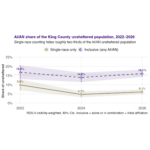
This report presents an analysis of unsheltered American Indian and Alaska Native (AI/AN) homelessness in King County, Washington. The Urban Indian Health Institute, Chief Seattle Club, and the University of Washington co-led it, reanalyzing the biennial UW/KCRHA King County Point-in-Time (PIT) survey of people experiencing unsheltered homelessness, conducted using respondent-driven sampling. Drawing on the survey years fielded from 2022 to 2026, the report finds that the federal single-race reporting standard undercounts the AI/AN population by roughly 2.6-fold. When AI/AN people are counted inclusively, that is, alone or in combination with another race and with tribal affiliation credited, they make up about around 16 percent of the unsheltered population in 2026, instead of around 5 percent that the HUD single-race format records. This result is consistent across the survey period even as unsheltered homelessness grew countywide, so the estimated number of unsheltered AI/AN people rose from about 1,303 on a single night in 2022 to roughly 1,905 in 2026. The analysis compares the two counting definitions and examines the shelter-access gap, demographics and tribal affiliation, health and chronic homelessness, families with minor children, and the geographic distribution across Seattle Metro and the other King County subregions. It recommends adopting and reporting the inclusive AI/AN measure and improving the PIT methodology and services through ongoing partnership with Native-led organizations.
Learn More : Project Report
Point of Contact: Zack Almquist
People Living in Vehicles
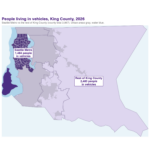
This short report presents a needs assessment of people living in vehicles in King County, WA. It is part of a series produced through a joint project between the University of Washington and the King County Regional Homelessness Authority analyzing the biennial Point-in-Time survey to understand unsheltered homelessness. Using respondent-driven sampling surveys from 2022 to 2026, the report estimates roughly 3,967 people living in cars, vans, and RVs on a single night in 2026, or about 5,460 over a full year. The analysis is broken out by vehicle size (small vs. large) and geography (Seattle Metro vs. the rest of the county) and covers demographics, health and chronic homelessness, domestic violence, service needs, and families with minor children. The report recommends sanctioned safe parking with hygiene, dump-station, and pet-friendly capacity as the most direct response.
Learn More : Project Report
Point of Contact: Zack Almquist

University of Washington Elections Database (UWED)
The University of Washington Elections Database (UWED) housed at the Center for the Study of Demography and Ecology at the University of Washington offers a publicly available data set on estimated racial demographics in electoral precincts in Washington State. We also provide an additional data set on language minority groups by each county in Washington State. The project was funded by WA State Senate Bill 5597.
Learn More: Project Website
Point of Contact : Scott Allard

Discrepancies in Local and Census Housing Data
Seattle’s 2020 Census population count was 3.8% or nearly 30,000 lower than the Census Bureau’s Population Estimate published in the same year. The City of Seattle solicited CSDE Research Scientist Jessica Godwin and Demographic Analytics consultant Ron Prevost to explore possible causes of this discrepancy and avenues toward improving the Census Bureau’s housing data for Seattle ahead of the 2030 Census.
Learn More : Project Report
Point of Contact: Jessica Godwin

Accessibility in King County Parks
The 2025 Applied Research Fellowship program worked with King County Parks to provide both quantitative and qualitative assessments of the accessibility of King County’s parks. Isochrone algorithms were used to quantify the walking distance to parks while accounting for topography and physical infrastructure. An on-the-ground assessment coupled with interviews of park users was carried out at Dick Thurnau Memorial Park to examine the presence and quality of park amenities and signage. The research team of 3 UW graduate students and 2 UW undergraduates was led by CSDE Research Scientist, Jessica Godwin.
Learn More : Project Report
Point of Contact: Jessica Godwin

Spatiotemporal Trends in Local Business Closures
The 2024 Applied Research Fellowship program used proprietary data on businesses from Data Axle to understand trends in business openings and closures throughout King County. In collaboration with Public Health–Seattle & King County, the team looked at the spatial distribution of pharmacies, grocery stores, child care facilities, and third places and how that distribution has changed over time. For each jurisdiction in King County, the top 10 employers by size were reported. The research team of 3 UW graduate students and 2 UW undergraduates was led by CSDE Research Scientist, Jessica Godwin.
Learn More : Project Report
Point of Contact: Jessica Godwin
D4 Events
CSDE intentionally and deliberately sparks new collaborations and launches new research initiatives that effectively leverage the capacities of demographers, data scientists, health scientists and scholars of inequality. We do this through annual events with scientific exchanges organized around the theme of Demography, Data Innovation, and Population Disparities presentations organized by each Primary Research Area (PRA).
Learn More : Event Details
Point of Contact: Sara Curran