The CSDE community is deeply saddened by the passing of Alan Li
CSDE’s Senior Computer Specialist Alan Li passed Monday, February 23rd. We, his friends and colleagues, are devastated by this unexpected loss.
Alan was a kind and caring colleague. He was absolutely dedicated to providing the very best computing services for thousands of students, staff, and colleagues. He set a very high standard of IT systems and support and established CSDE’s computing core reputation. He also had a great sense of ironic humor. All who knew him benefited from his unique perspective on the world. While it was very hard to get him to take vacation, he was a world traveler, including serving as a US Peace Corps Volunteer in Haiti. He is survived by his son, who was the absolute center of his life. Alan Li will be deeply missed by all of us.
Share your thoughts and condolences
Please send us a photo, message, or memory of Alan.
Photos and Tributes:
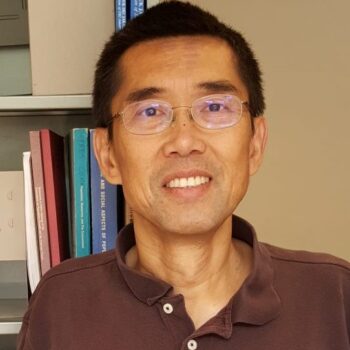
Sara Curran
CSDE Director
Alan was a wonderful member of the CSDE community. I share this picture of Alan from a recent gathering of CSDE staff and faculty. Alan always joined in our events with a holiday hat, halloween mask, or in the art projects and games. He always had a good chuckle and really enjoyed the fun competition. When I first met Alan, I didn’t recognize his fun nature. Instead, my first impression was of someone who took his work really seriously and was not to be bothered with silly questions about computing. I was just slightly intimidated… but, I was so wrong in that first impression. Instead, what I learned is that Alan cared deeply about fully understanding the nature of the problem you brought to him and then to provide you with a solution that worked completely. His sincerity and generosity of his time to me and each member of our community was unparalleled. I miss his daily presence and I miss bothering him about taking time off and using his many, many hours and days of accumulated vacation!
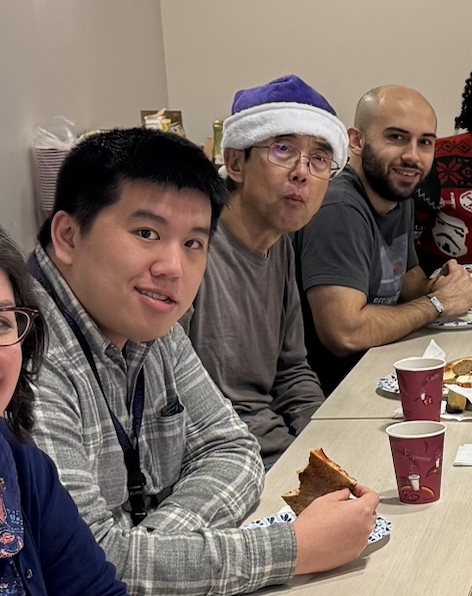
Matt Weatherford
CSDE IT Director
Alan and I worked together at CSDE for the past 17 years I can remember hiring him away from his work in Haiti. I called his reference in Port Au Prince and remember clearly the echoes, delays, and analog nature of that phone call. When he first came to Seattle with his wife and young son I remember having a social visit with them at our home in north Seattle – Alan and his family took the bus to visit us.
Alan graduated from the University of Washington school of computer science the year before I did (in 1990) This time period is probably foreign to many of you – it was a time before there was an internet as we know it now. It was only universities connected to it, and there was no commercial use allowed. There wasn’t even dial up for consumers yet. The only dial up at UW was so you could get into the VAX computer – and modems were expensive, and it was so slow, that you were better off living out of the Academic Computing Center down on Brooklyn to get your all-night assignments cranked out. This was back before Microsoft Windows was invented when computers were large, and unix, and line printers were 120 columns of text and had to be put in soundproof acrylic cages because they were so loud.
Around the time Alan and I were in the CS program, Steve Jobs came to the UW campus to promote his new computer the “NeXT” and its object-oriented user interface “NextStep” an early precursor to what would become Mac OS X
Alan and I were educated in Computer Science during a very different time than what we are seeing now – Technology and Computers were relatively new and held out a lot of promise for information sharing, community building, and “raising all boats” – These were the early, optimistic days of technologyBack in the 1990’s, the UW computer science program was still a part of the College of Arts and Sciences. So, when he joined CSDE, Alan, like me, had a kind of homecoming. Alan held at least 2 degrees that I know of from the university – a mathematics degree and a computer science degree. After the UW, Alan joined the Peace Corp and worked in Africa (Ivory Coast) – I hoped I would someday hear his stories from around this time.
I understand that after that, he next worked for a time in Haiti – not sure if this was a Peace Corp posting, or something else – but eventually he was teaching mathematics in a private School. Alan was a good teacher and could develop a well thought out curriculum ( Ask any staff member who took his “Advanced Excel” Class ). During his time teaching at that school he once told me he taught one of the children of the president of Haiti. I think at that time he was also responsible for arranging a presidential visit from Bill Clinton.Alan was a great engineer. He had an amazing ability to think through a proposed service offering from beginning to end – what would happen when the customer would have a problem, what kinds of problems those were likely to be, and what would happen when the customer would leave the university. He had also a keen eye for user lifecycles, technology, and what kinds of maintenance would be needed.
Alan and I hired more than a dozen student employees over the years – we enjoyed meeting them, discussing their merits after an interview, and predicting which students would stick around. Alan mostly was the person who mentored and trained them on the account request system, the help desk box, and how to answer the “top 10 questions” customers have. Under his guidance, Alan had the students write up a student systems administration handbook that we used for training and reference. Many of our help desk folks became excellent troubleshooters and went on to have amazing careers.
One of the many things that Alan and I agreed on was promoting the use of free and open source software and tools. For years we made the case to students in the CSDE 501/502 class that if you use expensive proprietary software to do analysis and then try to hand that off to a non-profit group, they may not be able to use it because they can’t afford the software license costs
Things I loved about Alan:
- He always thought of something I didn’t see
- He could logically think many steps ahead, predicting impact and articulating it well
- Alan excelled at reading documentation in great detail
- He preferred to do his own reading and troubleshooting rather than contacting vendor support – he considered that a last resort
- He would, maddeningly, never fail to find the flaw in your reasoning or plans, if one existed
- He offered help in a humble way as to make the customer feel like a partner rather than scolded for not knowing something
- Alan was the guy who would get a help request, ask the customer to send over their code, reproduce the problem on his own, and make brilliant, practical suggestions for how to get things working better
In his later years, having endured years of emailing customers only to have them ask questions in a way that indicated they hadn’t read what he wrote – Alan became a bit more gruff… But if you could get past that, he was the trusted IT partner that you were looking for.
A couple days ago I looked up a UW Group that includes all CSDE computing users that opted in to our services. This was something users had to do themselves, not something we could do for them. It’s a rough indicator of the size of the community that an IT group at UW is supporting. Needless to say, we supported a LOT of UW community members over the years – I found that group size at more than 9,700 people! But we didn’t even turn on that tracking until 5 years after Alan started, so its easily been over ten thousand students, faculty, and staff who used the CSDE Computing systems during his tenure.
I will miss Alan, and I will never forget his significant contributions to the Population Research Community, and the high standard of support he embodied for me, our staff and our customers.
Aimée Dechter
Former CSDE Training Program Coordinator
I was in awe of Alan and Matt Weatherford after I learned they were the only two full-time staff members on the computing core. At the time I moved to UW, they managed to serve as many students and affiliates and maintain and operate at least as many computing systems and resources as other top population centers that had at least twice as many fulltime staff. Alan and Matt were Rock stars.
Alan had an extraordinary work ethic and dedication to CSDE’s mission. I will also remember Alan as extremely kind, sincere, resilient, and determined. I owe him a debt of gratitude for his support and generosity. It was a pleasure working with Alan and getting to know him. We developed a friendship after we ran into each other at the library years ago. He was carrying a stack of books to read with his son, Albert. Alan enjoyed talking about Albert and I was always riveted listening and moved by the love and thought Alan put into parenting. I often stopped by Alan’s office after the CSDE seminars to say hello. Alan would invariably smile and talk about Albert.
I can’t imagine a more mutually loving supportive relationship than Alan’s and Albert’s. I hope Albert will always feel his father rooting for him.
My heart goes out to Alan, Albert, and their family and friends.
The following letter was written by Aimee Dechter, at the request of Matt Weatherford, to be included in Alan’s personnel file – Alan and Aimee had worked closely for several weeks to produce an impact report for the T32 training grant that required meticulous attention to detail.
Thank you for the opportunity to acknowledge Alan’s important contributions to the training program. He provides outstanding support throughout the year and plays a vital role in the preparation of the T32 institutional training grant application.
Alan shies away from taking credit for his work and is modest about his accomplishments and knowledge. However, I would like to acknowledge his exemplary work on creating tables for the training grant application. He is fastidious and has deep insight into the logic of the tables and their substantive purpose. For example, I have been cc’d on emails and at meetings where he most graciously corrected others who misinterpreted the tables or asked him to produce something for a table that was inconsistent with the logic of the table and NIH’s instructions. Alan is very thorough and double-checks his own work, the information given to him, and the entries made by other people. An example of this that also demonstrates the speed in which he responds to the needs of the training program, is the vital role he played this spring to find a file that I created originally for the 2016 grant renewal application with data that I needed for Table 6A in the 2018 resubmission. After searching the training directories unsuccessfully, I assumed I inadvertently deleted the file so I asked Alan about restoring an older backup. Even though he was in the processes of moving the old R drive to the new location, he restored a backup. Ironically, I only found the file when I searched on CSDEAC and found an email I sent to Alan in 2016 that identified the directory in which the original file was stored. There was an email record of the location in part because Alan took it on himself in 2016 to calculate the aggregated measure based on the individual data I created because he noticed that I had forgotten to enter some of the aggregated values in the Table.
I work most closely with Alan on Table 6A, the most complex of all the tables. Characteristics of entrants and applicants into each of the graduate programs that are affiliated with the CSDE Training Program are compared to the characteristics of fellows who entered the same graduate program that same year, for each of the past five academic years. It is easy to conflate the cohort in which students entered their graduate program with the cohort in which they became a fellow. Moreover, it is difficult to determine when fellows enter their graduate program because some students delay entry for a year and others have been enrolled at UW previously in other degree programs. The table requires working with multiple sources of data that are not always consistent. In 2016, Alan and I worked together to receive permission from each of the Affiliated Academic Departments to access the records of their applicants and students.
Alan keeps abreast of new UW data systems and tools, which reduced the time needed to compile data on disability for Table 6A for the 2018 resubmission. The first time I worked on the training grant Alan introduced me to UW data I did not know about and connected me to the people who gave me permission to access the data. Most recently, Alan has assisted me in working with the UW Enterprise Data Warehouse (EDW) repository of institutional data for the T32 application and for other training reporting purposes. In January, I had spent a month working with EDW to create a student level file of enrollment in core demography courses that could be aggregated by school, department, and demographic characteristics of the students. However, I could find no files that would allow me to map department code to department name. Enrollment Information Services in the Division of Enrollment Management offered to do the match for me in a couple of weeks. I emailed Alan 4:38 PM on a Friday to ask if he knew what files on EDW would allow me to map Department code to Department name. By 7:48 AM Saturday morning, Alan created a spreadsheet that had a column for the department code and another for the name.
Alan’s empathy and generosity make him a valued colleague. After spending another month with institutional data, painstakingly creating a file that would allow me to aggregate the teaching evaluations of these core demography courses across students, time, instructors and course numbers that changed over time, I asked Alan if he would help me to learn how to use the EDW system more effectively for future reports. Alan told me, “Don’t worry, I have your back”, and he did. He created a tool that allows me to extract selected data from EDW more easily. I have not yet worked much with the tool because I had to move on to other tasks, however, by helping the training program to navigate the massive complicated EDW, Alan will allow CSDE to prepare reports that evaluate the quality of the training program and its reach across colleges and departments in ways we were unable to previously.
Alan contributes to the training program in other ways. As you know, he presents information and answers students’ questions at the Population Proseminar when you and he visit each fall. Alan is service oriented and very responsive. He replies quickly to questions or problems during the week, and often in the evenings and on weekends. He is very patient and a standout in keeping others informed. He often lets me know he is working on the problem and explains the steps he has taken to address it. Nothing has ever fallen through the cracks. Alan provided the same outstanding support to me before I was a CSDE staff member. He was always very responsive to the loss of VPN, even on weekends.
Alan contributes to making the computing core one of the most important resources for trainees. Each year when they evaluate the training program, the feature they appreciate most often is the computing resources and support. CSDE visitor, Mark Hayward, reported that when he met with the trainees after his seminar and asked them about the training program they raved about the computing core.
In sum, Alan provides great support to the training program. I could not ask for a more supportive and knowledgeable colleague.
Mitch Francisco
Former CSDE Student Systems Administrator
I had the privilege of working closely with Alan for four years during my undergrad at UW alongside Matt W., as a part-time student system admin. It’s safe to say I can’t imagine my college experience without him. He was more than a boss to me, he was a mentor in every sense of the word.
Alan had a leadership style that reminded me of a strict but caring father figure. He was direct, honest, and held high standards, but you always knew it came from a place of wanting the best for you. He pushed me to grow, and at the same time, he always made it clear that school came first. I’ll never forget how supportive he was whenever I needed time to focus on coursework or exams.
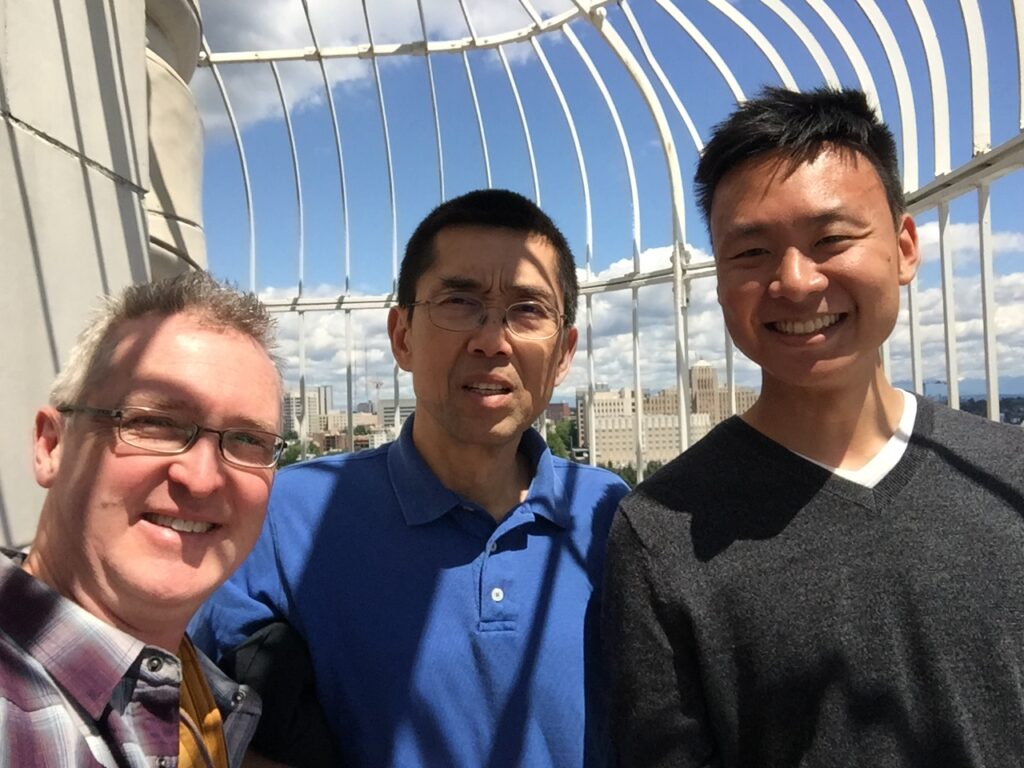
Some of my favorite memories with him are the simple ones, watching over his shoulder as he explained a technical topic, learning about Windows server administration, playing ping pong at the Hub, and going out for dim sum with a trip to Smith tower!
I feel incredibly lucky to have learned from him. His technical influence, his here to help attitude, and bias for action, all have stayed with me well beyond college.
Joanna Medina
Former CSDE Staff
I worked with Alan for almost seven years, and he was always incredibly patient whenever I had computing questions. I also bumped into him at the light rail a few times and we would exchange a few quick words while he was on his way to work, and he always seemed just like himself. Every time I visited CSDE, I tried to stop by his office because I knew he was usually around.
Alan will truly be missed. His kindness, dedication, and quiet humor left a lasting impression on so many of us. I’m grateful for the years I had the chance to work with him.
Sending my deepest condolences to Alan’s family. I am so sorry for your loss. Rest in peace, Alan.
Steven Goodreau
Professor, Dept. of Anthropology
My main impression of Alan has always been how quietly thoughful he was. No matter what problem I came to him with, he would listen, pause, say something to himself, smile a little, and then magically fix the problem. I had the sense that it brought him great satsifaction to be the remover of obstacles for his fellow humans like this. The other impression came the few times that I saw him with his son, and just how full of joy and pride he was around him. My deepest gratitude to Alan. And my deepest condolensces to all of Alan’s family, especially his son Albert.
Kate Barch Heaton
LCS/Haitian Project
I am sad to hear of Alan’s passing and will keep his loved ones in my thoughts. I overlapped briefly with Alan when we both served as volunteers in Haiti. Alan was kind, funny, quick-witted and good with the kids at the school. I thought then, and especially looking back now, that he was brave in many ways. He entered a community where he did not blend in and handled it with courage and humor. That is very hard to do. I also enjoyed hearing his stories, learning from him and joking around in passing. To his son all of you who have known and loved Alan in more recent years, I am sorry for your loss.
Phi Hurvitz
Former UW/CSDE staff
I had the privilege of working at CSDE one door away from Alan for about four years.
Alan’s level of skill at system administration was at a level I have rarely seen over my 3+ decades in scientific computing. Alan had the ability to think through computing problems or proposed system changes as thought experiments, following them through from beginning to best case and worst case scenario outcomes. He carefully thought through every proposal, with particular attention to negative unintended consequences. While people wanting computing support usually just want to get something done, they often do not think about potential down sides. Alan’s ability to see the big picture as well as minute details led to many better decisions and avoidance of probably even more bad decisions.
My first interaction with Alan was when he was supporting the UW Data Collaborative, before I joined CSDE staff. There were some data sets in the Enclave that were too large to handle effectively as flat files. I suggested the use of PostgreSQL for storage and analysis, and within a week, Alan responded that he had set up a system that was ready to use. That’s just one example of Alan’s dedication and unusually rapid support of his clientele.
A few months ago I was driving into the Asian Family Food Center at 135th & Aurora. Alan was just coming out of the store with his son. We made eye contact, smiled, and waved at each other. That’s my last memory of seeing Alan–smiling and waving at me.
Alan liked doughnuts.
Emily Lust
Former CSDE Help Desk employee
I worked with Alan for three years in CSDE as the help desk’s Computer Support Technician. He was always kind and patient whenever I came to him with questions or for advice, whether it was something technical or simply trying to better understand one of our customers. Alan demonstrated an incredible work ethic, and he was genuinely easy to work alongside, or to just chat with about what we each did over the weekend. I’m shocked and deeply saddened by the news of his passing. My heartfelt condolences go out to everyone at CSDE, to his friends, and of course to his family.
Erin Carll
UW Center for Evaluation & Research (CERSE)
I am so sorry to hear about this devastating loss. Though I probably only spoke to Alan in person a couple times, we communicated via email on many occasions over the years – usually to discuss something related to the CSDE terminal servers. I always felt very well taken care of by Alan and very much appreciated his kindness. I hope Alan passed at peace and I am sending my condolences to all who knew and loved him.
June Yang
CSDE Research Scientist
Alan was always my go-to person for any CSDE computing questions. He responded quickly, took action right away, and helped my team resolve issues in no time. He was a genuinely trusted colleague and friend. I truly cherish the conversations we had, as well as the thoughtful baby gift he prepared for my family. He will be deeply missed.
Carlos Becerra
Colleague at CSDE’s Northwest Federal Statistical Research Data Center
Every weekday between 7:00am and 7:30am I walk to the light rail station in Northgate in my commute to work. The last few years, I would often walk behind two guys who would leave the apartment complex in front of my house and engage in what seemed like interesting conversations from what I was able to to eavesdrop. Their backs to me, I could only see their large backpacks, hats, and clothing that fit a little too big, while not being baggy. I always imagined that they were on their way to school, either at UW or North Seattle College, and having nothing better to think about in the 12 minute walk, I imagined them being roommates sharing their experiences as grad school students. One afternoon about a year ago, as I was leaving my driveway, I saw one of the two guys going out for a jog, this time his front facing me. “Is that….Alan, from the CSDE?”, I thought. No way! But sure enough, that day I realized Alan was my neighbor. From then on I would smile every time they walked in front of me remembering how our brain can pull tricks on our perceptions. The quiet older gentleman computing wiz from work can totally pull the grad-school look and jog like an athlete. From then on I frequently saw Alan starting or ending a jog. The last time I saw him in the neighborhood, he was running laps around the park in front of the Target as if he was training for a marathon. This makes his passing all the more unexpected.
Alan was a kind man. I could tell it was in his nature to help people from very seemingly simple gesture. I once arrived late to a crowded CSDE meeting and he immediately stood up and pulled a chair for me, letting me take his stop on the table. He then passed me a plate and utensils and offered to hand me any food I wanted. I don’t think he knew I was his neighbor but he sure treated me like one.
Thalia Freamon
Former CSDE Coworker
I can’t believe this. He will be so missed. When I worked in the front office, he was one of a handful of people who arrived as early as me and we had some interesting conversations. When he fixed something on my computer, I would ask him what he did. My interest was that I should be able to fix it myself the next time, but he would do a funny little hand gesture I think to indicate that he had no time for teaching. It was interesting listening to him and Matt Weatherford talking shop. It was SO far over my head. I have met his son. My heart goes out to him.
Please email csde_help@uw.edu if you have any trouble.