Spring Schedule for CSDE Workshops and Working Groups
In spring quarter, CSDE will be hosting a workshop series and several working groups. Students, faculty, and staff are all welcome to register and we welcome registrants from outside the University of Washington for our remote workshops as well.
Please reach out to CSDE’s Training Director, Jessica Godwin (jlg0003@uw.edu), if you have additional workshops you would like to see offered in the future and we will do our best to accommodate those requests. View the schedule as a pdf here.
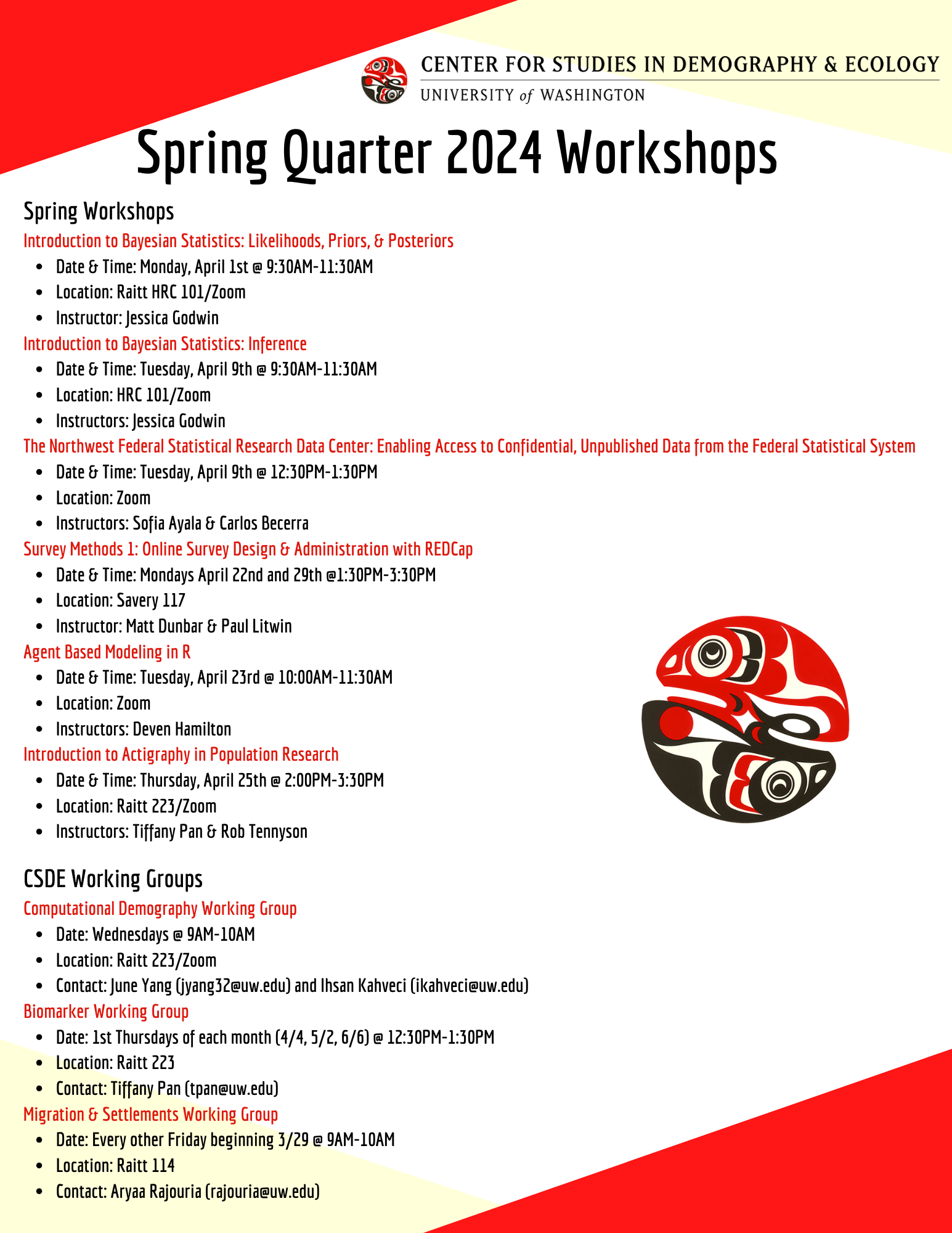
CSDE Workshops
No remaining workshops this quarter.
CSDE Working Groups
- Computational Demography Working Group
- Date: Wednesdays @ 9AM-10AM
- Location: Raitt 223/Zoom
- Contact: June Yang (jyang32@uw.edu) and Ihsan Kahveci (ikahveci@uw.edu)
- Biomarker Working Group
- Date: 1st Thursdaysof each month (4/4, 5/2, 6/6) @ 12:30PM-1:30PM
- Location: Raitt 223
- Contact: Tiffany Pan (tpan@uw.edu)
- Migration & Settlements Working Group
- Date: Every other Friday @ 9:00AM starting March 29th
- Location: Raitt 114/Zoom (meeting link)
- Contact: Aryaa Rajouria (rajouria@uw.edu)
*New* Postdoctoral Fellow: Department of Sociology, Anthropology, and Criminal Justice
*New* Celebration of LaShawnDa Pittman’s New Book
Van Draanen, Williams, Hill, and Rowhani-Rahbar Consider How the Earned Income Tax Credit Affects the Likelihood of Substance Use Disorder and Overdose
CSDE Affiliates Jenna Van Draanen (Child, Family & Population Health Nursing), Emily Williams (Health Systems and Population Health), Heather Hill (Public Policy & Governance), Ali Rowhani-Rahbar (Epidemiology), and colleagues released research in Drug and Alcohol Dependence, titled “No Change in Substance Use Disorders or Overdose After Implementation of State Earned Income Tax Credit (EITC)“. Inadequate income is associated with higher likelihood of experiencing a substance use disorder (SUD). This study tests whether the earned income tax credit (EITC), which issues supplemental income for workers with children in the U.S., is associated with lower rates of SUD and fatal overdose.
*New* NIH Virtual Workshop: The Future of Scientific Conferencing (6/6, 6/7, 6/11/24)
The NIH will host a virtual workshop on June 6th, 7th, and 11th. This workshop will bring together diverse perspectives from multiple disciplines to explore advantages, barriers, gaps, and opportunities in the future of scientific conferencing for the behavioral and social sciences. The workshop will incorporate innovative evidence-informed approaches to showcase the potential of a virtual platform for learning, networking, and participant engagement. See the full agenda and register here.
Schedule:
Workshop Day 1: Thursday, June 6, 12:00–5:00 p.m. ET
Engagement Day: Friday, June 7, 12:00–3:00 p.m. ET
Workshop Day 2: Tuesday, June 11, 12:00–5:00 p.m. ET
Agenda Now Available: https://www.labroots.com/ms/virtual-event/future-scientific-conferencing/agenda-pdf
The overarching aims are to:
- Facilitate interdisciplinary communication and networking.
- Identify crosscutting scientific gaps regarding the role of behavioral and social science factors in scientific convenings.
- Inform practical strategies for designing effective, engaging, and sustainable scientific conferences and meetings.
Areas of focus include:
- Technological innovations that enable virtual and hybrid approaches
- The impact of these approaches on diversity, equity, inclusion, accessibility, and belonging (DEIAB) of participants and attendees
- Environmental sustainability
Engagement day (June 7, 12:00–3:00 p.m. ET) includes several activities designed to promote networking and connection, from live poster presentations and Q&A sessions to 1:1 networking opportunities and multiple small group breakout discussions, led by workshop speakers and NIH staff.
Korinek and Colleagues Examine War-related Life Course Stress and Subjective Aging
CSDE Affiliate Kim Korinek (Sociology, University of Utah) released an article with colleagues in Innovation in Aging, titled “War-related Life Course Stress and Late Life Subjective Age in Northern Vietnam“. The role of early life stressors in subjective aging is weakly understood, especially in low- to middle-income countries. This paper investigated how early life stressors encountered in armed conflict influence subjective age among Vietnamese older adults who experienced war over decades of their early life. Results suggest wartime stressors, especially war’s malevolent environments and severe childhood hunger, experienced in many conflict-affected populations globally, have the potential to subjectively ‘age’ survivors. Yet, not all war exposures are equal, and some may yield psychological and socioeconomic resources that support healthy aging.
Allard Quoted by Northwest Public Broadcasting on Ballot Rejection Rates
CSDE Affiliate Scott Allard (Public Policy & Governance) was quoted in an article by Northwest Public Broadcasting about mailed ballot rejections in Mason County, WA. Despite concerns that the county’s ballot rejections are rising, Allard points to his team’s research which shows that the county’s rejection rate is around the same or below the state average of 1%. Allard discusses various factors that might affect rejection rates such as voters’ unfamiliarity with envelope design, signature issues, and the type of election. Read more in the full article by Lauren Gallup. The article also contains an audio version of the story for listening.
*New* Call for Abstracts: Workshop on Migration and Mobility Research in the Digital Era (Due 6/10/24)
The Max Planck Institute for Demographic Research (MPIDR) will host workshop on September 3rd in Exeter, United Kingdom as a satellite session of the Conference on Complex Systems. The aim of this satellite session is to bring together researchers from different fields and practitioners from around the world to facilitate a conversation on the use of innovative digital data sources, new methodologies, empirical findings, and critical challenges of studying migration and mobility in the digital era. Organizers welcome submissions of abstracts on ongoing or published work that fit the topics of the event. Authors must submit abstracts by June 10th. Read about the topic and other details here.
Summary: The recent availability of massive amounts of digital data have profoundly revolutionized research on migration and mobility, enabling scientists to quantitatively study individual and collective mobility patterns at different granularities as generated by human activities in their daily life. Harnessing such digital data offers many new opportunities to study migration and mobility and fill in the gaps left by traditional data. At the same time, such innovative data sources also come with several limitations, biases, and challenges, which have led to diverging research methodologies and frameworks, requiring even greater effort in their operationalization and communication to stakeholders and policy makers.
A New Study on Risk Perception and Communication Amongst Coastal Emergency Managers is Released by Moore, Jean, Korfmacher, Bostrom, Errett, and Co-authors
CSDE Affiliates Ann Bostrom (Public Policy & Governance) and Nicole Errett (Environmental & Occupational Health Sciences) co-authored new research in the International Journal of Disaster Risk Reduction, titled “Coastal emergency managers’ risk perception and decision making for the Tonga distant tsunami“. This article was lead-authored by Ashley Moore, a PhD student in Environmental Health Sciences, and involved several other UW trainees including recent postdoctoral scholar Cassandra Jean (Environmental & Occupational Health Sciences) and master’s student Matias Korfmacher (Public Health, Urban Planning). This study looked at coastal emergency managers’ risk perception and communications surrounding the distant tsunami caused by the 2022 Tonga volcano eruption. While emergency managers perceived tsunami risk to be low, they took precautionary measures and alerted the public. Study findings show that their actions were driven by community characteristics and anticipated reactions, in addition to unique aspects of the tsunami risk.