1-on-1 Meetings are available with Professor Torche: Signup Here
Join us for a talk by Dr. Florencia Torche (Stanford) about “The Effect of COVID Infection on Infant Health: Trends over the Course of the Pandemic.” Please make special note that this talk is in Parrington Hall room 220. Dr. Torche is Dunlevie Family Professor in the School of Humanities and Sciences at Stanford University. Her research and writing focus on social inequality and social mobility, educational disparities, and marriage and family dynamics. Her recent scholarship has extensively studied the influence of early-life exposures and circumstances –starting before birth– on individual health, development, and wellbeing using natural experiments and causal inference approaches
This Thursday, March 30, from 11:00AM-12:30PM, CSDE Training Director Jessica Godwin will be teaching the second installment of our 3-part Bayesian Workshop Series — Introduction to Bayesian Statistics: Inference. The workshop will be in-person in Savery 121. Please register here.
This Thursday, March 30, from 11:00AM-12:30PM, CSDE Training Director Jessica Godwin will be teaching the second installment of our 3-part Bayesian Workshop Series — Introduction to Bayesian Statistics: Inference. The workshop will be in-person in Savery 121. Please register here.
The Computational Demography Working Group will host their first meeting of the quarter on March 29th, 2023. The plan for the meeting will be to do introductions, catch up and discuss the quarter as well as recruit for the Response Driven Sampling (RDS) Point in Time (PIT) Count for 2023. This point in time estimate is used to estimate the total population of unsheltered people experiencing homelessness in King County in collaboration with the King County Regional Homelessness Authority. CSDE training core PI Zack Almquist will be leading this discussion and recruitment. For more information find the main RDS PIT page here.
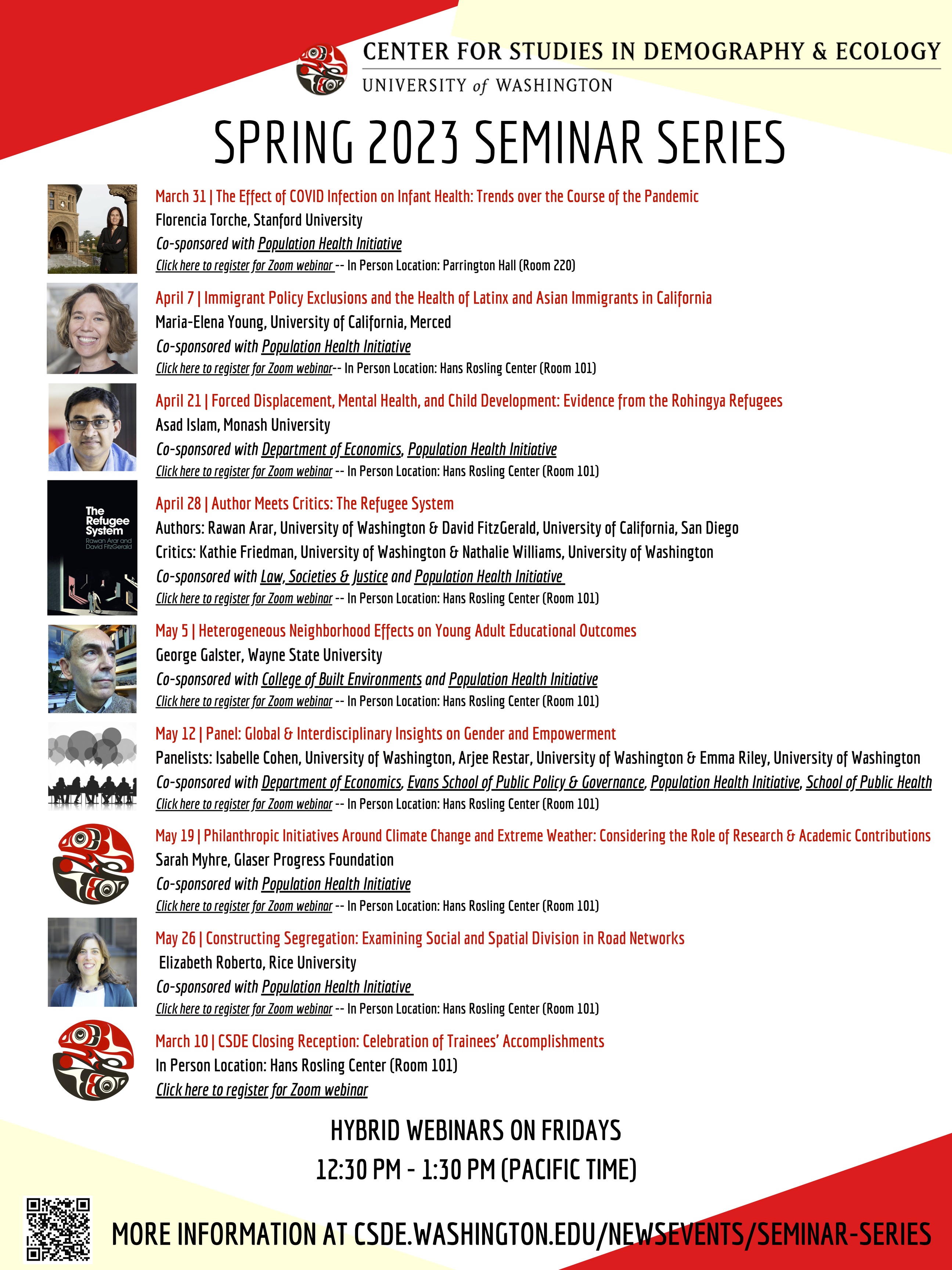
We are looking forward to welcoming the cherry blossoms in a few short days. They are starting to bloom on the quad! While you’re visiting them, do stop by CSDE in Raitt Hall to say ‘hello’! This spring quarter we’ll be welcoming an excellent array of lectures from UW affiliates and Visitors during our CSDE Seminar. Our first seminar will be in 220 Parrington Hall, but all others will be in 101 Hans Rowling Center. Come to the first seminar and pick up a free poster! Meanwhile, joining us to share their outstanding research are: Dr. Florencia Torche (Stanford University) who is an expert on social inequality and mobility with particular expertise around how early-life exposures on individual health outcomes (March 31); Maria-Elena Young (UC Merced) who is an expert on the impact of immigration policy on immigrant health and well-being (April 7); Asad Islam (Monash University) whose expertise is in the field of development economics with particular foci on children, education, and women (April 21); Dr. Rawan Arar (UW Law, Society & Justice) and Dr. David Fitzgerald (UC San Diego) who are experts on refugees and will discuss with two critics their recent book – The Refugee System: A Sociological Approach (Wiley 2022) (April 28); George Galster (Wayne State University) who is an expert on neighborhood effects on young adult education (May 5); Dr. Isabelle Cohen (UW Evans School), Dr. Arjee Restar (UW Epidemiology), and Dr. Emma Riley (UW Economics) who are each experts on gender empowerment in their own fields of research (May 12); Dr. Sarah Myhre (Glaser Foundation) who is a leader on climate science communication (May 19); and, Dr. Elizabeth Roberto (Rice University) who researches social and spatial inequality, especially residential segregation (May 26). Don’t miss out on attending our end of the year event on June 2, when we celebrate all the Trainees and their accomplishments! Finally, we’re launching a new outreach event – A CSDE Open House – on May 5 from 3:30-5:30pm. Join us in Raitt Hall, enjoy refreshments, and meet each other and staff, while hearing about all the research happening with CSDE support!
Congratulations to our CSDE poster presenters for their great work! We want to give extra congratulations to CSDE Fellow Lizzy Pelletier (Evans School) for winning the best poster award at our Winter 2023 Lightning Talks & Poster Session. Pelletier’s presentation, titled “How state policy design shapes eligibility for paid family leave: Evidence from Washington state,” used WA administrative data to demonstrate the differences in who is eligible various states’ family leave policies within a single population. Many thanks to our other speakers Delaney Glass (Anthropology), Aryaa Rajouria (Sociology), and June Yang (Sociology), Training Director Jessica Godwin, and student coordinator Aja Sutton (Geography) for another great Session! We also want to thank everyone who attended and, especially, our wonderful CSDE Faculty Affiliates Panel of poster judges: Kyle Crowder, Jamie Goodwin-White, and Michelle O’Brien. It was wonderful to see so many familiar and new faces as we work to re-establish in-person events and strengthen our sense of on-campus community. We hope to see you at our End of Year Reception on June 2nd celebrating our CSDE Trainees’ successes!
CSDE Affiliates John Leverso , Jerald Herting, and April Fernandes recently published a new article titled, “Life Course Statuses of Justice‑Involved Youth Transitioning to Adulthood: Differences and Change in Offending and Mental Health” in Journal of Developmental and Life-Course Criminology. The research uses data from the Northwestern Juvenile Project (a sample of 1829 youth that were incarcerated in Cook County Illinois and then followed for approximately 5 years.
CSDE Affiliate Michael Spencer has just been appointed as Dean of the School of Social Work. Dr. Spencer has been serving as Interim Dean since January 1, 2023. Dr. Spencer is Director of Native Hawaiian, Pacific Islander, and Oceania Affairs at the Indigenous Wellness Research Institute at the School of Social Work. Dr. Spencer focuses his research, teaching, and serve on health equity, including physical and mental health, access to services, the role of racism and discrimination, and culturally centered, community-based, participatory research. The CSDE community was lucky to learn from Dr. Spencer during his seminar presentation on the impact of COVID 19 on Native Hawaiian communities.
CSDE Affiliate Janelle Taylor (University of Toronto) recently had a summary of her team’s research findings about dementia care was published in The Conversation. The article provides an overview of the team’s recent research. The specific focus is on elders who are experiencing dementia but are “kinless”, which means they have no living spouse or children to care for them. Based on a review of years of medical records by her and her team, Dr. Taylor explores the surprisingly diverse paths that lead people to this situation, as well as the many forms of care they receive, and from whom. She reminds us that such forms of precariousness are both common and unpredictable.
CSDE Affiliate Chiyoung Lee recently published two papers that employed network analyses to explain health outcomes. The first paper, “Network Analysis of Adverse Childhood Experiences and Cardiovascular Diseases“, was published in SSM-Population Health. It demonstrates how network analysis, a statistical method that estimates complex patterns of associations between variables, can be used to model adverse childhood experiences and cardiovascular diseases. In the second paper,”Racial Differences in C-reactive Protein, Depression Symptoms, and Social Relationships in Older Adults: A Moderated Network Analysis.”, published in Biological Research For Nursing, Lee introduces moderated network analysis as an integrative approach to assess the moderation effects of race on the relationship between C-reactive protein and depression symptoms in older adults.